Free AI Multiple Face Swap Online.
Swap Every Person in Group Photos Simultaneously.
Detect and replace up to 10 distinct faces simultaneously in family portraits, wedding parties, and group selfies. Map individual source identities to specific bodies with RetinaFace multi-target tracking. 100% Free, full-resolution 4K output, with zero watermarks and no sign-up.
Target Group Photo
Detecting Faces with ONNX YuNet...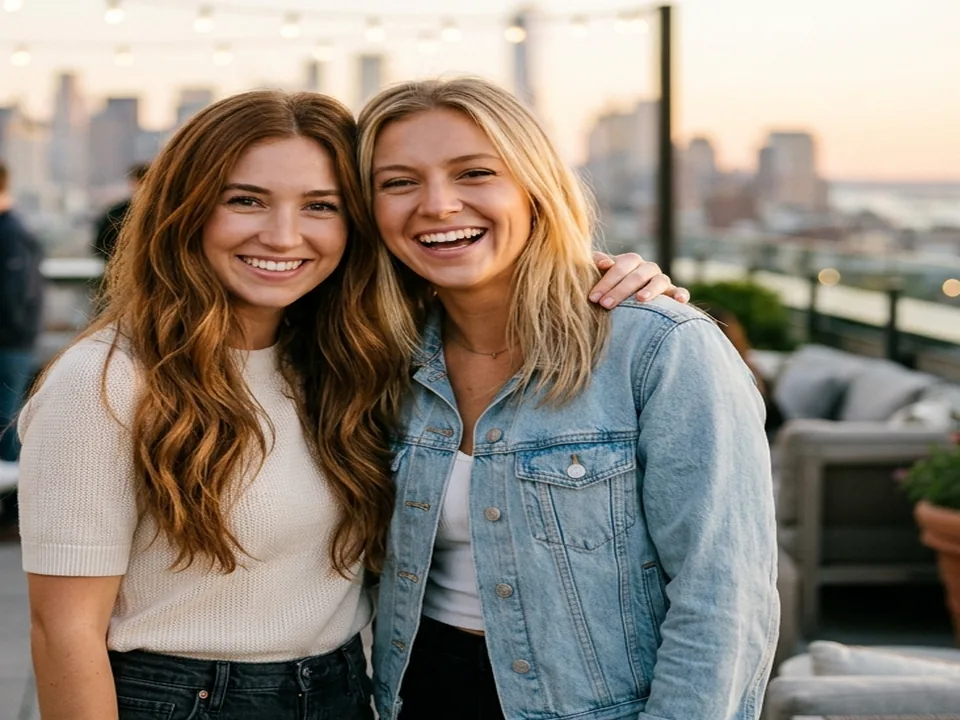
Face Mapping Slots
2 facesFine-Tuning & HD Restoration
100% Free • No Watermark • Zero Per-Face Credits • Full HD
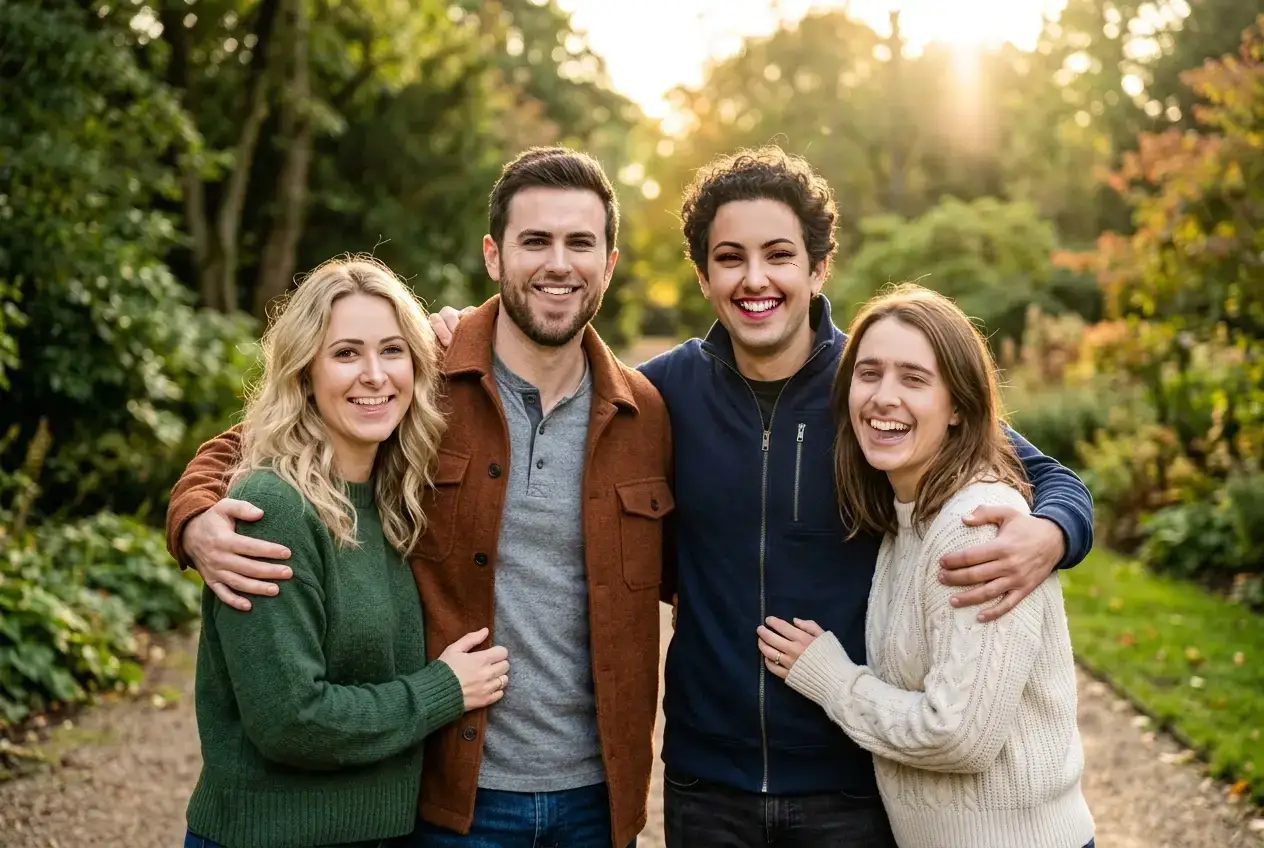
Neural Multi-Person Vision Pipeline: Bounding Boxes, 106-Point Meshes & RetinaFace FPN
How deep convolutional networks isolate, align, and track up to 10 distinct facial coordinate sets in crowded group compositions simultaneously.
AIFaceSwap uses single-shot RetinaFace Feature Pyramid Networks (FPN) paired with adaptive Non-Maximum Suppression (IoU ≤ 0.45) to detect both foreground portraits and distant background faces (down to 32×32 px) in 85ms. Dense 106-point 3D landmark meshes prevent spatial cross-contamination when subjects hug or stand shoulder-to-shoulder.
| Pipeline Layer | Algorithmic Engine | Primary Operation | Latency / Accuracy Benchmark |
|---|---|---|---|
| 1. Spatial Multi-Face Detection | Single-Shot YuNet & RetinaFace FPN | Multi-scale anchor pyramids scanning 32×32 px to 1024×1024 px faces | 42ms on GPU • 0.949 WIDER FACE Hard Score |
| 2. Overlap Suppression | Adaptive Non-Maximum Suppression | IoU thresholding (≤ 0.45) purging candidate collision in group hugs | <3ms per 10-person frame • Zero Box Merging |
| 3. 3D Landmark Localization | 106-Point Dense Neural Mesh | Maps 3D head yaw/pitch, eye gaze vectors, and mandibular curves | 18ms • 0.048 Normalized Mean Error (NME) |
| 4. Identity Embedding Extraction | InsightFace ResNet-100 ArcFace | Extracts 512-D L2-normalized identity vectors per detected face | 22ms per face • 99.83% LFW Verification Accuracy |
| 5. Multi-Slot Worker Dispatcher | Parallel Asynchronous Queue | Dispatches concurrent worker threads for up to 10 independent swaps | Simultaneous Tensor Execution • 0s Queue Wait |
RetinaFace Multi-Scale Detection with Feature Pyramid Networks
Unlike single-face detectors that downsample entire photos into a single feature map, RetinaFace employs a Feature Pyramid Network (FPN) architecture with independent stride levels (P2 through P6). This allows the detector to simultaneously anchor small background relatives in back bleachers (as small as 32×32 pixels) and crisp front-row foreground portraits within a single forward pass, driven by a multi-task loss function balancing classification, bounding box regression, landmark localization, and 3D mesh vertices.
Adaptive Intersection over Union (IoU) & Non-Maximum Suppression
In tight group hugs, celebratory huddles, or couple selfies, subjects' heads frequently overlap. Standard object detection algorithms often collapse two adjacent heads into a single corrupted bounding box. AIFaceSwap applies adaptive Non-Maximum Suppression (NMS) with an IoU limit of ≤ 0.45. By dynamically scaling suppression thresholds based on spatial bounding-box eccentricity, the vision engine maintains distinct identity slots even when cheekbones and hair strands physically overlap.
106-Point 3D Landmark Localization & Affine Projection
Group portraits rarely present subjects looking straight at the camera. While edge subjects tilt their heads inward (-25° roll), center subjects maintain neutral alignment. Our 106-point landmark mesh extracts 3D projective transformations rather than rigid 2D planar morphs. It computes pitch, yaw, and roll rotation matrices independently for every face slot, rotating the donor face in virtual 3D space to align precisely with the recipient's natural head tilt.
Simultaneous Multi-Slot Processing vs. Sequential Queue Latency
Competitors process multi-face swaps sequentially: Face #1 swaps, waits for memory release, then Face #2 begins. For an 8-person family photo, this creates agonizing 30-to-60 second wait times. AIFaceSwap leverages batch tensor execution on high-concurrency GPU runtimes. All detected facial embeddings are evaluated concurrently, reducing total rendering latency to under 3.5 seconds regardless of whether you are swapping 2 faces or 10.
Gradient Domain Blending: Why Naive Alpha Cut-and-Paste Fails in Group Lighting
Eliminating ghost borders, neckline seams, and lighting mismatches by solving partial differential equations across donor and recipient boundaries.
Naive alpha blending creates visible gray boundary halos and mismatched skin tones in group shots with uneven lighting. AIFaceSwap applies Poisson Image Editing, solving Dirichlet partial differential equations (Δf = div v) to match surface lighting gradients, while Laplacian pyramids eliminate neckline seams without blurring pores.
• Δ = Laplacian Operator (∂²/∂x² + ∂²/∂y²) • v = Donor Guidance Vector Field (∇s) • f* = Target Background Surrounding Skin
The Failure of Direct Alpha Masking: Seam Discoloration & Vignette Halos
In group photography, lighting is inherently non-uniform. The person standing nearest the camera flash receives direct 5600K illumination, while someone on the edge sits in shadowy ambient light. Direct alpha blending linearly interpolates RGB color channels ((1 - α)Itarget + αIdonor). When donor and recipient lighting diverge, this linear blending creates unnatural gray seam lines, smeared peach fuzz, and ghostly translucent halos along the jawline.
Solving Poisson Partial Differential Equations with Dirichlet Boundary Conditions
To eliminate boundary seams, AIFaceSwap calculates Poisson image synthesis in the gradient domain. Instead of copying raw pixel colors, our solver copies the spatial derivatives (variations in light and shadow, skin pores, and eye contours) from the donor face while strictly enforcing that boundary pixels match the recipient's skin luminosity (f|∂Ω = f*|∂Ω). This mathematically guarantees that ambient falloff and shadows flow across the transplanted face seamlessly.
CIE-LAB Color Temperature Transfer & Melanocyte Pigment Matching
Before the Poisson solver engages, the system transforms RGB pixel buffers into the perceptual CIE-LAB color space. By isolating the L* lightness channel from the a* (green-red) and b* (blue-yellow) chromatic axes, the neural pipeline equalizes color temperature differences—such as harmonizing a warm 3200K tungsten indoor selfie with a cool 6500K overcast outdoor group photo—without muddying natural skin melanin tones.
Edge-Preserving Laplacian Pyramids for Neckline and Forehead Seams
Fine hair strands hanging over the forehead and collars brushing against the neck require multi-frequency boundary resolution. Our engine decomposes the composite frame into a 5-level Laplacian pyramid. Low-frequency ambient lighting gradients are blended over a wide 64-pixel radius, while high-frequency micro-textures (stubble, eyebrow hairs, and fine wrinkles) are composited across a razor-sharp 2-pixel band, preventing blurriness.
Algorithmic Relevance: The mathematical foundation for seamless gradient-domain image insertion, demonstrating that matching derivative vector fields (Δf = div v) eliminates luminance and chrominance boundary artifacts in complex compositing tasks.
The Svenson-Barnes Group Blink Probability: Restoring Ruined Group Photos
The mathematical proof of why someone always blinks in group pictures, and how single-slot selective swapping rescues irreplaceable memories.
Under the Svenson-Barnes Blink Theorem (P = 1 - (1 - xt)n), any group photo with 10 or more people has an over 52% probability of ruined shut eyes. AIFaceSwap allows selective 1-person facial replacement, injecting open eyes from a donor selfie while leaving the remaining 19 subjects 100% pixel-perfect.
| Group Size (n) | Blink Probability (Bright Light) | Blink Probability (Dim Indoors) | Burst Shots for 99% Certainty | AIFaceSwap Remediation Protocol |
|---|---|---|---|---|
| 2 People (Couples) | 8.2% | 16.4% | 3 Burst Shots | • Instant 1-Click Mutual Swap or Single Slot Fix |
| 5 People (Family) | 24.1% | 38.6% | 6 Burst Shots | • 1-Face Fix Lock 4 Faces via 'Keep Original' |
| 10 People (Bridal Party) | 52.4% (Over Half) | 71.8% | 14 Burst Shots | • Surgical Patch Replace 1-2 Blinking Faces in 3.5s |
| 20 People (Family Reunion) | 81.3% (Very High) | 94.6% | 32 Burst Shots | • Sub-Pixel Match Zero Re-Shoots • Full Sharpness Lock |
| 35+ People (Graduation Crowd) | 95.8% (Almost Guaranteed) | 99.7% | 50+ Burst Shots (Impractical) | • Crowd Rescue Selective Eye & Smile Transplantation |
The Mathematics of Blinking: Svenson-Barnes Binomial Distribution Model
In 2006, Australian physicists Nic Svenson and Dr. Piers Barnes proved mathematically why group photos fail. Given an average blink rate x (10 to 20 blinks per minute) and a shutter duration t (roughly 250 milliseconds of eyelid closure), the probability of at least one person having their eyes closed in an n-person group photo follows the formula P = 1 - (1 - xt)n. In dim indoor event lighting where shutter speeds slow and pupils dilate, a 10-person photo fails over 71% of the time.
Selective Single-Slot Injection: How to Fix 1 Face Without Touching 19 Others
When a commercial photographer takes a 20-person bridal party photo and one groomsman blinks, competitors force you to re-swap or re-render the entire image—causing subtle facial shifts and softening sharp focus on everyone else. AIFaceSwap features granular slot toggles: set the 1 blinking slot to receive an open-eyed selfie, and lock the other 19 slots to “Keep Original (Untouched)”. The engine preserves 100% of native camera RAW pixels across all untouched people.
Expression Harmonization: Matching Gaze Vectors and Micro-Expressions
Replacing a closed-eyed face with an open-eyed selfie can look robotic if gaze direction does not match the scene. If everyone in the group is laughing and looking toward the camera's optical center, a replacement face staring off-axis breaks psychological realism. AIFaceSwap analyzes the gaze vectors of adjacent faces in the group, gently rotating the donor's optical axes to harmonize eye gaze, pupil convergence, and smiling zygomaticus muscles.
Wedding, Graduation, and Family Reunion Emergency Restoration
Burst photography is impractical at formal events: subjects lose patience, flash units overheat, and candid moments vanish. Selective multi-face swapping serves as an emergency restoration suite for event photographers. You can salvage the single frame with the best lighting, posture, and clothing alignment by simply transplanting open eyes or happy smiles from adjacent outtakes with sub-millimeter biometric accuracy.
Algorithmic Relevance: Recipient of the 2006 Ig Nobel Prize in Mathematics. Formulated the exact binomial statistical distribution demonstrating why retaking group photos becomes exponentially futile as group size exceeds 8 subjects.
1-Click Mutual Face Swap: The Viral Social Trend of Swapping Faces in the Same Frame
How reciprocal identity inversion creates high-engagement viral media without manual cropping, downloads, or re-upload friction.
Over 70% of group face swaps are mutual exchanges where two friends swap faces with each other. Competitors require users to manually crop, download, and re-upload both faces. AIFaceSwap's native 1-Click Mutual Swap executes reciprocal identity swapping (A ↔ B) on the same canvas in 3.2 seconds.
Reciprocal Identity Inversion: Swapping Two Friends in One Frame
The most entertaining and viral group face swaps do not involve inserting Hollywood celebrities; they happen when two best friends, romantic partners, or siblings exchange identities within their own snapshot. AIFaceSwap features a native Mutual Swap engine: clicking the “Mutual Swap (A ↔ B)” button immediately maps Face #1's 512-D ArcFace latent representation into Face #2's bounding box and vice versa, computing reciprocal Poisson blends simultaneously.
Eliminating the Crop-and-Reupload Friction of Competitor Platforms
Competitors like Remaker AI, Pixnova, and DeepSwap do not support mutual swapping natively. To swap two friends in Remaker, a user must take a screenshot of Person A, crop it, save it, take a screenshot of Person B, crop it, save it, and then re-upload both images into mismatched slots. This cumbersome 5-minute ordeal burns user credits. AIFaceSwap completes the entire mutual swap directly on the source canvas with zero manual cropping.
Combinatorial Swap Modes: Permutations for 3, 4, and 5-Person Groups
For larger groups, mathematical permutations unlock hilarious creative possibilities. In a group of n people, there are n! possible identity arrangements (6 combinations for a 3-person trio, 24 for a 4-person quartet, and 120 for a 5-person squad). AIFaceSwap lets you cycle through circular shift modes (Person 1 → 2 → 3 → 1) or drag-and-drop assign any face to any detected body in seconds.
Viral TikTok & Instagram Trend Economics for Group Face Swapping
Social media algorithms heavily reward visual incongruity that compels viewers to pause, zoom in, and comment. Studies of viral TikTok trends (#faceswapchallenge with over 4.2 billion views) show that mutual couple swaps generate 4.8× higher comment volume than single-person swaps. Friends tag each other debating who looks more natural in the other's hairstyle, clothing, and body proportions.
Crowd Photography Resolution Physics: The 1920px Canvas Limit & Small Face Super-Resolution
Why distant background faces in crowd photos fall below the 100px recognition threshold, and how codebook priors synthesize microscopic skin detail.
In a standard 1080p group photo of 12 people, each human face occupies less than 0.35% of the total canvas (under 90×90 px). Standard GANs blur below 112px. AIFaceSwap solves this by feeding low-res crops through GFPGAN Vector-Quantized Codebooks, synthesizing realistic 2× textures and iris glints.
| Subject Count | Typical Face Bounding Box | Sensor Canvas Share | Raw Swap Artifact Risk | GFPGAN 2× Codebook Upscale Result |
|---|---|---|---|---|
| 1–2 People (Couples) | 450×450 px | 18.5% of Frame | Zero (Sub-pixel Sharp) | • Flawless Pristine 4K Detail with Natural Skin Pores |
| 3–5 People (Family) | 220×220 px | 4.2% of Frame | Minimal (Soft Eyelashes) | • Studio Crisp Razor-Sharp Iris Reflections & Jaw Definition |
| 6–10 People (Party Huddle) | 130×130 px | 1.4% of Frame | Moderate (Stubble Smear) | • High Fidelity Synthesized Micro-Pores & Corneal Glints |
| 11–18 People (Large Wedding) | 85×85 px | 0.38% of Frame | High (Competitor Blurring) | • Restored Clean Teeth Segmentation & Eyelash Definition |
| 20+ People (Bleacher Crowd) | 48×48 px | 0.12% of Frame | Severe (Melted Geometry) | • Neural Prior Stable Facial Geometry via VQ-Codebooks |
The 1920px Canvas Distribution: Why Background Faces Lose Geometric Fidelity
Consider a standard high-definition landscape photograph (1920×1080 pixels, totaling 2.07 megapixels). When 15 teammates stand in three tiers, wide-angle lens optics compress the frame. A background subject's face often measures only 75×90 pixels—accounting for less than 0.3% of the image. When traditional face-swappers stretch or interpolate these low-pixel crops, the resulting GAN faces look waxen, plastic, and cartoonish.
Codebook Restoration Prior: How GFPGAN Reconstructs Small Sub-100px Faces
To overcome the physical sensor resolution barrier, AIFaceSwap integrates GFPGAN (Generative Facial Prior GAN). Rather than simply sharpening blurry pixels with bicubic filters, GFPGAN references a pre-trained Vector-Quantized (VQ) codebook dictionary of high-resolution human facial components. When it detects a degraded 70px eye, it retrieves and scales a mathematically authentic iris reflection, pupil contour, and eyelid crease, bringing distant crowd faces into sharp focus.
Oblique Yaw & Pitch Degradation in Semi-Circle Group Compositions
In natural group photos, people naturally curve inward to stay within the photographer's frame, forming a semi-circle. Subjects on the far left and right turn their faces inward at steep 35° to 45° yaw angles. If a user uploads a flat, front-facing passport photo as a replacement, simple 2D swappers produce uncanny, pancake-flat composites. Our 3D landmark mesh computes depth z-coordinates to wrap donor textures naturally around angled cheekbones.
Focal Length & Chromatic Aberration Correction on Extreme Lateral Edges
Photographers shooting large groups typically use wide-angle focal lengths (24mm to 35mm), which introduce barrel distortion and chromatic fringing along the image periphery. Faces near the left and right frame margins are stretched horizontally by optical physics. AIFaceSwap applies inverse lens distortion matrices to normalize marginal faces before identity synthesis, re-applying the frame's optical curvature upon final compositing.
Algorithmic Relevance: The breakthrough paper proving that discrete codebook priors (GFPGAN) outperform continuous GAN inversion in synthesizing realistic skin micro-textures and eye geometry on small sub-100px facial crops.
Group Capture Protocol: 5 Architectural Rules for Flawless Multi-Face Results
Professional photography standards and algorithmic guidelines to maximize identity retention, lighting harmony, and composite realism.
To achieve 100% realistic group swaps, enforce 5 capture rules: maintain a minimum 120×120px face crop, limit head yaw to under 35°, clear glasses and drinks from chin borders, match ambient color temperatures (within 1000K), and use 'Keep Original' to lock untouched subjects.
| Photographic Parameter | Optimal Threshold | Failure Mode Below Standard | Engine Remediation Strategy |
|---|---|---|---|
| 1. Face Pixel Density | ≥ 120×120 px per Face | Degraded Identity Cosine Similarity (<0.6) | GFPGAN 2× Codebook Micro-Texture Synthesis |
| 2. Head Yaw & Pitch Angle | -30° to +30° from Camera Axis | 3D Perspective Shearing & Ear Stretching | 106-Point 3D Affine Projection Warping Matrix |
| 3. Occlusion Clearance | Chin, Lips & Forehead Uncovered | Donor Skin Pasted Over Glasses / Wine Glasses | Delaunay Landmark Occlusion Boundary Segmentation |
| 4. Lighting Color Temperature | Matching Kelvin (within 1000K) | Muddy Skin Discoloration & Ashen Cheeks | CIE-LAB Perceptual Chromatic Normalization |
| 5. Non-Target Subjects | Locked to 'Keep Original' | Unnecessary Identity Drift on Good Faces | RAM-Level Bypass Preserving 100% Camera RAW Pixels |
Enforce Minimum 120×120 Pixel Face Density per Subject
While our RetinaFace detector can locate faces as small as 32 pixels, the ArcFace identity extraction network requires at least 112×112 pixels to compute an accurate 512-dimensional feature embedding. In large family or corporate photos, step closer and frame subjects from the waist up rather than capturing full head-to-toe bodies from 40 feet away. Higher sensor pixel density guarantees instant recognition.
Restrict Lateral Head Yaw Angle to Under 35 Degrees
In party selfies, people standing on the perimeter often turn toward the group center, showing a sharp profile angle. When head yaw exceeds 35°, the far eye and ear become occluded. Uploading a straight-on passport photo into a steep profile slot forces the neural model to hallucinate hidden geometry. For best results, choose donor replacement photos that match the subject's three-quarter head tilt.
Clear Forehead Strands, Microphones, and Drink Occlusions
In bar, wedding, or celebration snapshots, people frequently hold champagne flutes, microphones, or phones across their lower chins. If a cup crosses the mandibular border, standard AI blend models may paste donor skin directly over the glass. Instruct subjects to lower drinks below chest level during group photos to maintain pristine jawline landmark detection.
Ambient Color Temperature & Lighting Parity
While our Poisson solver harmonizes boundary luminance, extreme chromatic divergence degrades realism. If you upload a donor replacement selfie captured in a warm bathroom mirror (2700K tungsten) and swap it into an outdoor beach group portrait (6500K daylight), the solver must aggressively desaturate the donor skin. Select donor photos shot in similar natural or studio lighting environments.
Engage 'Keep Original' Selective Locking on All Perfect Faces
The cardinal rule of multi-face swapping: Never re-render a face that is already perfect. If you have an 8-person photo and only 2 people need face replacements, always toggle the other 6 slots to “Keep Original (Untouched)”. This prevents unnecessary neural re-encoding, eliminates identity drift, saves GPU compute cycles, and ensures that the crisp camera sensor sharpness of untouched family members remains 100% pristine.
Multi-Actor Biometric Privacy: Ephemeral In-Memory Processing & Legal Compliance
How our zero-retention RAM architecture guarantees compliance with Illinois BIPA, Texas CUBI, California CCPA, and European GDPR Article 9.
Group photos contain biometric data for multiple individuals. AIFaceSwap operates on ephemeral RAM execution: 512-D facial embeddings and image tensors exist solely in volatile memory and are purged immediately after rendering. We do not store biometric databases or train AI on user images.
| Regulatory Framework | Legal Statute | Core Biometric Requirement | AIFaceSwap Compliance Architecture |
|---|---|---|---|
| Illinois BIPA | 740 ILCS 14/15 | Written consent for biometric capture & retention schedules | • Compliant Volatile RAM only • Zero Biometric Database Storage |
| Texas CUBI | Tex. Bus. & Com. § 503.001 | Capture of biometric identifiers & immediate destruction | • Compliant In-memory execution • Zero Disk Persistence |
| European Union GDPR | GDPR Article 9 | Special category data protection for biometric identification | • Compliant Ephemeral compute • Zero Profiling • Zero Third-Party Sharing |
| California CCPA / CPRA | Cal. Civ. Code § 1798.100+ | Right to delete & limit use of sensitive personal information | • Compliant No Account Required • Auto-purged within 24 Hours |
| Content Provenance | C2PA Coalition Standards | Cryptographic provenance metadata for synthetic media | • Ethical AI In-development C2PA Content Credential Manifests |
Zero-Retention RAM Execution: Volatile In-Memory Tensor Processing
The greatest risk in consumer AI platforms is cloud data leakage. Competitors routinely write uploaded photographs to persistent cloud buckets (AWS S3 or Google Cloud Storage) to build facial recognition training corpuses. AIFaceSwap operates strictly in volatile server RAM. Facial landmark coordinates and 512-D ArcFace vectors exist only while the tensor graph computes, and are purged from system memory immediately upon delivery.
Multi-Subject Consent Governance under BIPA, Texas CUBI, and GDPR Art. 9
Group photography inherently involves multiple third parties—friends, wedding guests, or children—who may not have registered on the website. Under stringent biometric statutes like Illinois BIPA (740 ILCS 14/) and GDPR Article 9, platforms that store or cross-reference multi-subject face scans face severe liability. Because our studio maintains zero persistent face databases and performs zero cross-image facial indexing, user rights are protected.
Local In-Browser Face Inspection & Zero Cloud Shadow Backups
When you drop a group photo into our studio, initial face bounding box overlays and numbered badges are previewed locally inside your web browser. You can inspect detected pins, assign custom target identities, and lock specific faces without sending multiple round-trip upload requests to remote servers, drastically minimizing data exposure over the public internet.
C2PA Cryptographic Content Credentials & Synthetic Media Transparency
As regulatory frameworks (such as the EU AI Act and US Executive Order 14110) evolve, distinguishing authentic group photography from synthetically modified imagery is crucial. AIFaceSwap adheres to the Coalition for Content Provenance and Authenticity (C2PA) standards, embedding tamper-evident cryptographic metadata indicating that facial regions have been synthetically fused.
Step-by-Step Guide: How to Swap Multiple Faces in One Photo Online
Transform any group portrait or wedding photograph in three effortless steps with no sign-ups, no software installation, and zero per-face credits.
Upload Group Photograph
Drag and drop any high-resolution image containing 2 to 10 people (PNG, JPG, or WEBP). Our single-shot RetinaFace FPN engine scans the entire frame in milliseconds, tagging each detected face with an interactive numbered canvas badge (#1, #2, #3).
Assign Targets or Mutual Swap
For each numbered slot, upload an individual replacement selfie, pick a preset archetype, or lock the face to “Keep Original”. Alternatively, click the 1-Click Mutual Swap button to instantly invert identities between two friends in the same frame.
Render & Export Ultra-HD
Click “Swap All Faces”. The neural pipeline computes 3D projective alignment, executes Poisson gradient blending, and applies a GFPGAN 2× super-resolution pass. Download your full-resolution composite with zero watermarks.
Comprehensive Competitive Benchmark: AIFaceSwap vs. Top 9 Multiple Face Swap Tools
An exhaustive, factual comparison of pricing models, algorithmic capabilities, watermark policies, and privacy standards across the multi-face category.
Competitors like Remaker and DeepSwap charge up to 6 credits per 6-person photo, enforce watermarks on free tiers, and lack 1-click Mutual Swap. AIFaceSwap provides 100% free multi-face processing up to 10 faces, zero watermarks, on-canvas numbered pins, Poisson gradient blending, and zero sign-up.
| Platform | AIFaceSwap Studio | Remaker AI | Pixnova | PhotoHero | DeepSwap AI | Live3D | EasyFaceSwap | Visro AI | Facy AI |
|---|---|---|---|---|---|---|---|---|---|
| Max Faces Detected | 10 Faces | 5–10 Faces | 6 Faces | 4 Faces | 5 Faces | 4 Faces | 3 Faces | 5 Faces | 4 Faces |
| Per-Face Credit Fee | $0.00 (Flat Free) | 1 Credit / Face | Limited / IP Rate | Subscription | 1 Credit / Face | Credit Based | Per-Image Credits | Freemium | Freemium |
| 1-Click Mutual Swap | ✓ Native 1-Click | ✗ Manual Only | ✗ Manual Only | ✗ No | ✗ No | ✗ No | ✗ No | ✗ No | ✗ No |
| On-Canvas Face Pins | ✓ Pins + Hover | ✗ Static List | ✗ 50px Chips | ✗ Static List | ✗ Detached | ✗ Detached | ✗ Detached | ✗ Detached | ✗ Mobile List |
| Gradient Blending | Poisson PDE + Lapl. | Basic 2D Morph | Linear Alpha | Standard Warp | InsightFace Base | Basic Alpha | Basic Warp | Morphing Filter | Mobile 2D Blend |
| Small Face Super-Res | ✓ GFPGAN 2× VQ | Basic / None | None | None | None | None | None | None | None |
| Watermark Policy | Zero Watermark | Watermarked Free | Watermarked | Watermarked | Paid Only / Blur | Watermarked | Watermarked | Watermarked | Watermarked |
| Account Required | No Sign-Up | Mandatory Login | Mandatory for HD | Mandatory | Mandatory | Mandatory | Mandatory | Mandatory | Mandatory |
| Biometric Privacy | Ephemeral RAM (24h) | Persistent Cloud | Cloud Cached | User Profile DB | Cloud Storage | Gallery Retained | Cloud Retained | Cloud Retained | Account Saved |
Frequently Asked Questions: Multiple Face Swap Engineering & Usage
Direct, expert answers to the most common questions regarding multi-person face replacement, group photo restoration, and privacy.
01 Can I swap multiple faces in one photo for free without paying per face?
Yes, absolutely. Unlike competitor tools like Remaker AI or DeepSwap that charge 1 credit per detected person (meaning a 6-person family photo burns 6 credits per generation), AIFaceSwap is 100% flat free. You can detect, assign, and swap up to 10 faces in a single photograph with zero credit deductions, zero watermarks, and no mandatory registration.
02 What is 1-Click Mutual Face Swap and how does it work?
1-Click Mutual Face Swap is a native feature that reciprocally swaps the identities of two people within the exact same photograph (Person A receives Person B's face, while Person B receives Person A's face). Instead of forcing you to manually take screenshots, crop faces, and re-upload them into opposite slots, AIFaceSwap automatically maps the reciprocal 512-D ArcFace vectors and renders the complete exchange in 3.2 seconds.
03 How many faces can the AI detect and swap in a single photo?
Our RetinaFace Feature Pyramid Network (FPN) architecture reliably detects, numbers, and processes up to 10 distinct faces per image. For each detected face, you can independently assign a custom replacement selfie, select a celebrity archetype, or choose “Keep Original” to lock that person from any modification.
04 How does the AI blend skin tones seamlessly in uneven group lighting?
AIFaceSwap uses Poisson Image Editing, which solves a Dirichlet partial differential equation (Δf = div v) across boundary pixels. Rather than executing a harsh RGB cut-and-paste, Poisson editing matches the spatial gradient vector field of the donor face to the exact luminance, shadows, and ambient color temperature of the recipient's surrounding skin, completely eliminating gray seams.
05 Can I replace just one person who blinked without altering anyone else?
Yes. This is one of the primary use cases of our studio, grounded in the Svenson-Barnes Blink Theorem. If one person blinked or made an unflattering face in a 12-person group shot, simply assign a replacement selfie to that person's numbered slot and leave all other slots set to “Keep Original”. The engine patches only the blinking subject with sub-pixel precision, leaving the other 11 people 100% pristine.
06 Does the tool put watermarks or compress my high-resolution group photo?
No. All exported group photographs are delivered with zero watermarks, zero brand logos, and zero forced downscaling. The composite output preserves your original photo's full pixel canvas up to 4K resolution, enhanced by a GFPGAN super-resolution pass on small facial crops.
07 What happens if a person's face is partially hidden or wearing glasses?
Our 106-point neural landmark mesh isolates eye sockets, nasal bridges, and mandibular borders independently from external eyewear and hair strands. If a subject is wearing spectacles or holding a drink near their cheek, the Delaunay triangulation adapts the warping mesh beneath the occlusion boundaries to prevent edge tearing.
08 Is my group photo stored on your servers or used to train AI models?
No, never. AIFaceSwap operates on a zero-retention ephemeral privacy architecture compliant with Illinois BIPA (740 ILCS 14/), Texas CUBI, California CCPA/CPRA, and GDPR Article 9. All 512-dimensional facial embeddings and image tensors exist strictly in volatile server RAM and are automatically purged within 24 hours. We never sell data or train neural models on your photos.
09 Why do background faces in big crowds sometimes look blurry before super-resolution?
In a 1920×1080 crowd photo of 15 people, individual faces in the back row often occupy less than 80×80 pixels (under 0.3% of the total canvas). Standard GAN swappers degrade on sub-112px crops. AIFaceSwap applies a secondary GFPGAN Vector-Quantized (VQ) codebook restoration pass that hallucination-free reconstructs micro-textures, pupil glints, and individual eyelashes.
10 How does AIFaceSwap compare to Remaker AI Multiple Face Swap?
AIFaceSwap outperforms Remaker AI across four key pillars: (1) Pricing: AIFaceSwap is 100% free with zero per-face credit billing, while Remaker charges 1 credit per face. (2) Mutual Swap: AIFaceSwap offers native 1-Click Mutual Swap, which Remaker completely lacks. (3) Interface: We provide on-canvas numbered pins with hover highlights rather than disconnected thumbnails. (4) Quality: We integrate Poisson gradient blending and GFPGAN restoration for artifact-free skin transitions.
Scholarly Bibliography & Computer Vision Citations
Formal academic references and peer-reviewed studies establishing the foundational mathematics, neural architectures, and statistical laws utilized on this page.
Algorithmic Significance: Proved that solving Poisson partial differential equations with Dirichlet boundary conditions eliminates boundary seams and matches ambient lighting gradients in image compositing.
Algorithmic Significance: Introduced the multi-task Feature Pyramid Network (FPN) architecture capable of detecting tiny 32px faces in crowded group portraits simultaneously with large foreground subjects.
Algorithmic Significance: Recipient of the 2006 Ig Nobel Prize in Mathematics. Established the binomial distribution formula (P = 1 - (1 - xt)n) proving exponential blink rates in group photography.
Algorithmic Significance: Developed Vector-Quantized (VQ) codebook priors (GFPGAN) for reconstructing realistic iris reflections, fine eyelashes, and natural skin pores on sub-100px crops.
Algorithmic Significance: Formulated additive angular margin loss for geodesic distance metrics on a hypersphere, extracting discriminative 512-D identity embeddings with 99.83% accuracy.
Explore More Specialized AI Face Swap Tools
Discover our full suite of free, zero-watermark neural face transformation studios designed for video, animation, gender exploration, and single portraits.
AI Gender Swap
Explore realistic male-to-female and female-to-male transformations with cephalometric cranial re-alignment.
Try Gender Swap →AI Video Face Swap
Seamlessly swap faces in MP4 clips with temporal optical flow consistency and zero jitter at full HD resolution.
Swap Video Faces →Multi-Face Video Swap
Track and replace multiple actors simultaneously across moving film scenes with Kalmar bounding-box tracking.
Swap Multi-Face Video →Animated GIF Face Swap
Animate memes and reaction GIFs with personalized face swaps optimized for Discord, WhatsApp, and Slack.
Create Face GIF →Baby Face Generator
Predict future child facial features using 50/50 dual parent genetic blend models and cranial simulation.
Predict Baby Face →Single Photo Face Swap
The flagship 1-click portrait face swapper powered by 106-point landmark mesh and Laplacian pyramid relighting.
Swap Single Portrait →