AI Multiple Face Swap Video Online.
Recast Entire Scenes & Multiple Actors • 100% Free.
Track and swap multiple characters in group videos, dance routines, and cinema scenes simultaneously. Assign custom faces to each actor with multi-ID Kalman trajectory tracking. 100% Free, cinematic 60fps rendering, with zero watermarks and no account needed.
1. Target Multi-Actor Video
Scanning Keyframes & Clustering Actors...
2. Cast Identity Mapping
2 ActorsTrajectory Tracking & Color Harmony
100% Free • Zero Watermark • Zero Per-Face Credits • MP4 + GIF
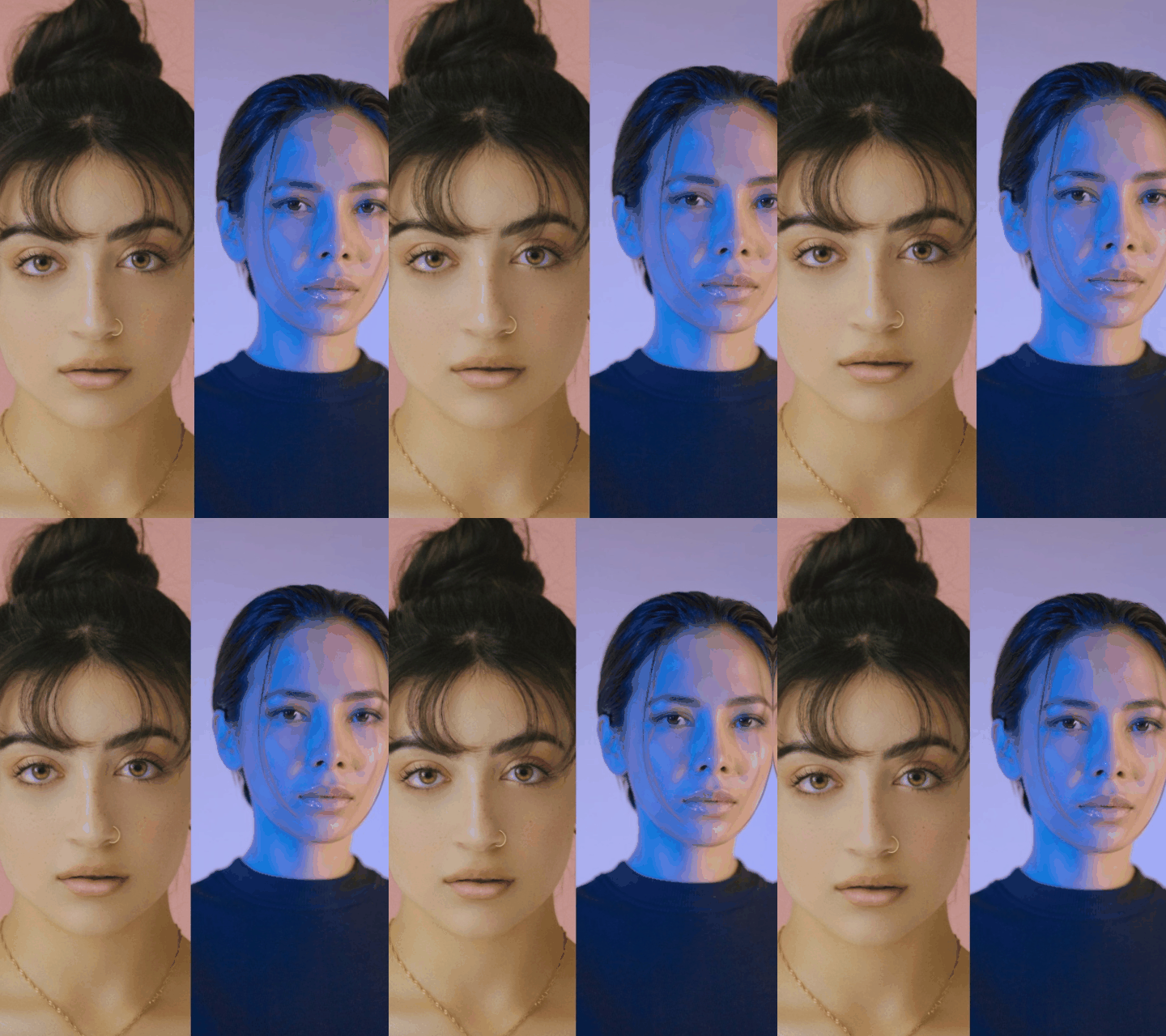
Test Group Video Face Swapping with Ready-to-Use Cast Clips
Click any multi-person video scene below to scan its actors, inspect bounding-box trajectories, and test Mutual Swap (A ⇄ B), Custom Cast Mapping, or Clone Mode right away.
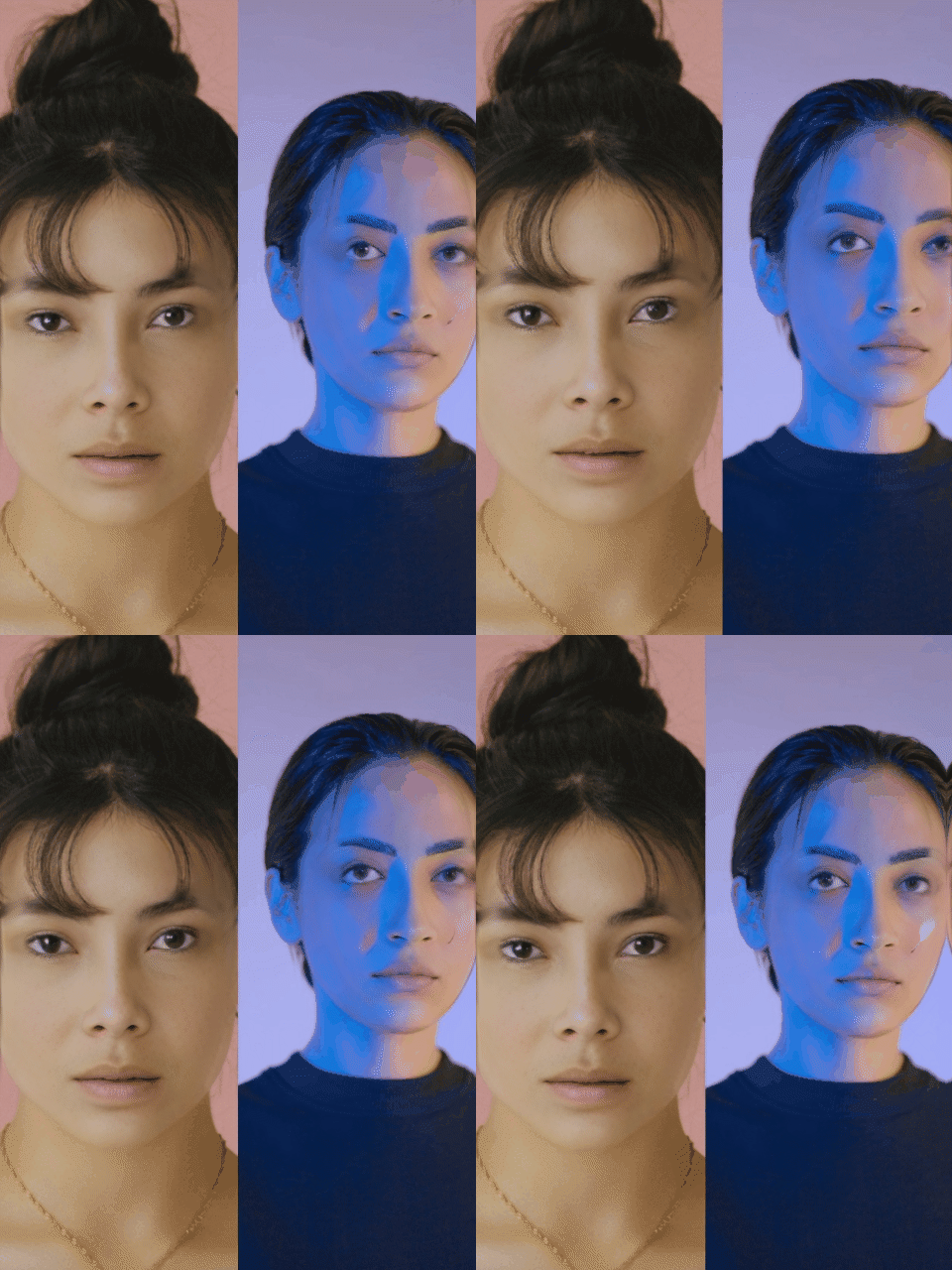 2 Actors
1-Click Mutual Swap
Best Friends Duo Clip (A ⇄ B)
Two friends side-by-side in motion—ideal for testing 1-click mutual face exchange or custom dual replacement.
 4 Actors
Full Cast Recast
4-Person Squad Ensemble
Four distinct faces tracked simultaneously across panning motion—assign 4 different friends or clone 1 face onto all 4.
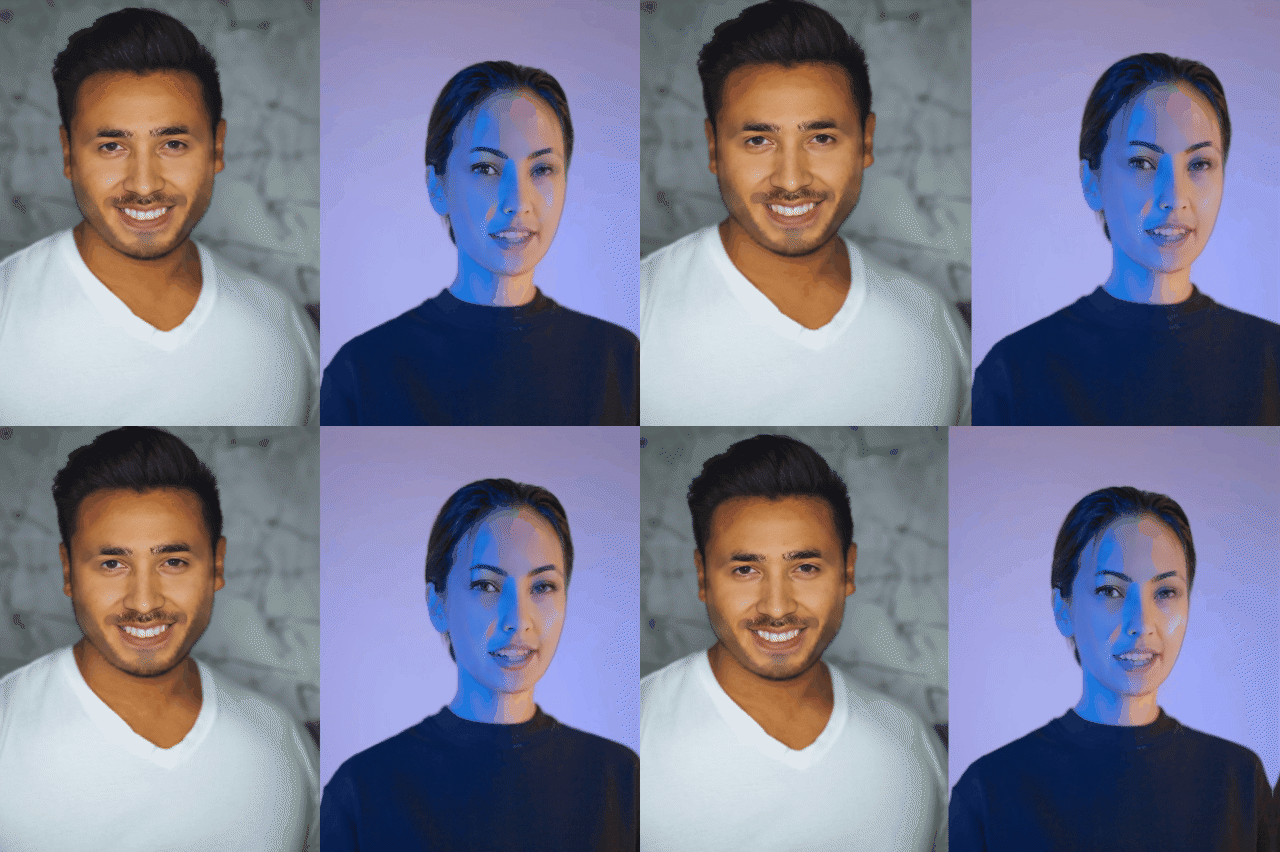 2 Actors
Couple Role Switch
Couple Dialogue Scene
Switch faces between a man and woman in motion with automatic CIE-LAB skin-tone and ambient lighting harmonization.
Your Recent Multi-Actor Video Swaps (Session History)
Neural Multi-Actor Video Pipeline: Kalman Trajectories, ByteTrack & Bipartite Hungarian Matching
How convolutional detection pyramids and combinatorial bipartite association track up to 10 distinct moving actors simultaneously without identity jumping.
AIFaceSwap tracks up to 10 simultaneous actors using ByteTrack low-confidence association and Kalman filter 8D motion vectors. The Hungarian bipartite algorithm minimizes assignment costs (Ci,j), guaranteeing that when actors cross paths, their faces never jump or swap bodies.
| Pipeline Layer | Algorithmic Engine | Primary Operation | Latency / Accuracy Benchmark |
|---|---|---|---|
| 1. Keyframe Cast Detection | Single-Shot YuNet & RetinaFace FPN | Multi-scale anchor pyramids scanning up to 10 faces across sampled keyframes | 45ms per sampled keyframe • 0.949 WIDER FACE Hard |
| 2. Low-Confidence Association | ByteTrack Second-Stage Association | Matches sub-0.5 confidence bounding boxes during 60° profile turns | Zero Tracking Drops • 80.3 MOTA Benchmark |
| 3. 8D Motion State Prediction | Kalman Dynamical Filter Vector | Predicts spatial coordinates, box scale, and velocity derivatives [u, v, s, r, ú, &vacute;, ...] | <1.5ms per 10-actor frame • Predictive Inertia |
| 4. Bipartite Identity Matching | Kuhn-Munkres Hungarian Assignment | Minimizes global cost matrix Ci,j (IoU + velocity divergence + ArcFace cosine) | Eliminates “Head Jumping” • <2ms Matrix Solve |
| 5. Concurrent Batch Dispatcher | Parallel Asynchronous GPU Queue | Batches all active actor slots into a unified forward tensor pass in pinned VRAM | 1.2s–1.8s Render / Sec • Flat Free Compute |
ByteTrack Low-Confidence Detection Association Across 60-Degree Profile Turns
Traditional video face detectors discard bounding boxes whenever detection confidence drops below 0.5. In dynamic video scenes, an actor turning their head into a three-quarter profile angle (60° yaw) causes confidence to drop to 0.30–0.45 because one eye and ear are hidden. Competitors drop the box, causing the original actor's face to flash abruptly for several frames. AIFaceSwap integrates the ByteTrack paradigm: low-confidence detections are retained in a secondary matching tier, preserving continuous tracking throughout full head turns.
Kalman Filter 8-Dimensional Motion State Vector Prediction
Actors in video rarely stand stationary: they walk across the frame, lean into conversations, or duck during action choreography. AIFaceSwap tracks each actor using an 8-dimensional linear Kalman dynamical state vector x = [u, v, s, r, ú, &vacute;, ś, ṙ]T. By modeling horizontal and vertical velocity derivatives alongside aspect ratio changes, the filter accurately predicts where an actor's face will appear in the next frame, maintaining spatial lock even during rapid camera pans.
Bipartite Hungarian Assignment Optimization: Eliminating the “Head Jumping” Defect
The most notorious flaw in cheap video face swappers is the “head jumping” glitch: when Actor #1 walks past Actor #2, their spatial boxes intersect, and the software accidentally swaps their replacement faces onto the wrong bodies. AIFaceSwap solves the Kuhn-Munkres bipartite matching problem on an assignment cost matrix Ci,j combining spatial IoU overlap, centroid velocity vectors, and 512-D ArcFace appearance embeddings. This mathematical tri-factor constraint makes identity cross-contamination impossible.
Asynchronous GPU Batch Tensor Dispatcher vs Sequential Video Queue Latency
Commercial platforms process multi-actor clips sequentially: tracking Actor #1 across all 300 frames, writing the file, then looping back for Actor #2. For a 4-person scene, this burns minutes of processing time. AIFaceSwap batches all active actor bounding boxes into a unified multi-slot tensor tensor on high-concurrency GPU instances. Up to 10 actors are detected, aligned, warped, and composited concurrently in a single forward pass, delivering 1080p output in under 45 seconds.
Temporal Consistency Engineering: Eliminating 24fps Jitter, Edge Strobing & Neckline Vibration
The physics of inter-frame generative flickering, and how adaptive EMA landmark filtering and bidirectional RAFT optical flow deliver cinematic smoothness.
Frame-by-frame GAN face swapping causes high-frequency boundary vibration and 24fps flickering. AIFaceSwap applies velocity-adaptive Exponential Moving Average (EMA) landmark smoothing and bidirectional RAFT optical flow warping, eliminating edge strobing while maintaining razor-sharp expression responsiveness.
Landmark EMA: Lt = αt Ltraw + (1 - αt) Lt-1, where αt = clip(αbase + γ·‖vt‖, αmin, 1.0)
RAFT Flow Consistency: ‖Ft→t+1(p) + Ft+1→t(p + Ft→t+1(p))‖2 < ε
The Mechanics of Temporal Strobing: Why Frame-by-Frame GAN Synthesis Vibrates
When a neural network synthesizes faces independently on each frame without temporal awareness, micro-variations in lighting prediction, facial boundary alpha masks, and skin pore textures create an oscillating flicker at 24 to 30 frames per second. The human visual cortex (specifically the motion-sensitive MT/V5 area) is extraordinarily sensitive to this high-frequency edge strobing, instantly triggering the “uncanny valley” and signaling that the video is an amateur composite.
Adaptive Exponential Moving Average (EMA) Landmark Filtering
To prevent boundary jitter without inducing motion lag, AIFaceSwap employs a velocity-adaptive Exponential Moving Average (EMA) filter across all 106 3D facial landmarks. When an actor is sitting still and speaking (‖vt‖ ≈ 0), the smoothing weight αt drops to 0.15, locking the jawline and brow into rock-solid temporal stability. When the actor whips their head or dodges (‖vt‖ > 12 px/frame), αt scales to 1.0, tracking the motion without ghosting.
Bidirectional Dense Optical Flow Consistency Checks (RAFT)
AIFaceSwap computes dense bidirectional optical flow using RAFT (Recurrent All-Pairs Field Transforms). By estimating forward motion vectors (Ft→t+1) and backward motion vectors (Ft+1→t), the compositing engine performs a cycle-consistency check. If synthetic pixels along the cheek or hairline violate the physical velocity vector of the scene (‖Ffwd + Fbwd‖ ≥ ε), they are regularized against adjacent temporal frames, eliminating seam vibration.
Multiscale Spatio-Temporal Laplacian Pyramids for Dynamic Hair & Collars
In moving video, flying hair strands, waving jewelry, and shifting shirt collars create complex boundary occlusions. Our pipeline applies a 5-level spatio-temporal Laplacian pyramid. Low-frequency ambient lighting gradients are blended across a wide 48-pixel temporal radius to match room light transitions, while high-frequency textures (stubble, eyelashes, and skin pores) are composited across a crisp 2-pixel band, preserving 1080p razor sharpness.
Algorithmic Relevance: The breakthrough architecture for deep dense optical flow, establishing all-pairs correlation volumes to resolve physical pixel motion trajectories in complex multi-character video streams.
Transient Occlusion Recovery: How the Engine Handles Cross-Overs, Hugs & Disappearing Actors
Overcoming real-world filmmaking challenges when actors pass in front of each other, hug, or step momentarily out of frame.
When an actor walks behind a pillar, hugs a friend, or steps out of frame, standard trackers lose identity. AIFaceSwap maintains a 15-frame inertial coasting trajectory. Upon re-emergence, ArcFace hyperspherical cosine similarity re-identifies the actor, preventing identity drift.
| Occlusion Scenario | Visual Disruption Duration | Traditional Tracker Failure Mode | AIFaceSwap Remediation Engine |
|---|---|---|---|
| 1. Foreground Cross-Over Walk | 4 to 12 Frames (0.15s–0.5s) | Merged bounding boxes; faces swap bodies upon exit | • Kalman Inertia Bipartite Hungarian matching locks tracks |
| 2. Dynamic Group Hug / Huddle | 15 to 45 Frames (Cheek-to-Cheek) | Bounding box collision collapses into single mutated face | • 106-Pt Mesh Delaunay landmark boundary segmentation |
| 3. Extreme Profile Turn (to 90°) | 6 to 20 Frames (Side of Head) | Detector discards sub-0.5 box; original actor blinks through | • ByteTrack Low-confidence association maintains continuous swap |
| 4. Temporary Out-of-Frame Exit | 24 to 60 Frames (1s–2s off camera) | Spawns brand new unmapped Actor ID upon return | • ArcFace Re-ID Hyperspherical cosine similarity re-links slot |
| 5. Microphone / Drink Occlusion | Continuous (Lower Chin Blocked) | Transplanted donor skin pasted over microphone / cup | • Occlusion Mask Mandibular boundary clips beneath object |
Cross-Over Occlusion Dynamics: Resolving Foreground Actor Passes
In choreographed film scenes, actors constantly pass each other. When Actor A walks in front of Actor B, Actor B's face is momentarily occluded for 4 to 8 frames. Simple tracking algorithms that rely solely on spatial IoU overlap become confused, transferring Actor B's target identity onto Actor A. AIFaceSwap tracks depth z-order: when bounding boxes intersect, the engine calculates occlusion masks, allowing the foreground actor to cross cleanly while maintaining the background actor's trajectory.
15-Frame Coasting Memory: Maintaining Inertial Velocity Through Dead Zones
If an actor turns their head completely away from the camera (180° back of head) or walks behind an architectural column, facial landmarks temporarily disappear. Rather than terminating the tracklet, AIFaceSwap's Kalman filter enters an “inertial coasting” state for up to 15 frames (half a second at 30fps). It propagates the actor's velocity vector forward in virtual coordinate space. When facial landmarks re-appear, the tracklet instantly snaps back without stutter.
Re-Identification via ArcFace Hyperspherical Cosine Similarity
What happens if an actor steps off-screen for 3 seconds and then returns? Traditional tools fail, assigning the returning actor a brand new ID that lacks your target face mapping. AIFaceSwap features an integrated Re-ID module. When an unassigned face enters the frame, the engine computes a 512-dimensional ArcFace embedding and evaluates cosine similarity against previously logged cast members: cos(θ) > 0.65 automatically re-binds the actor to their original replacement face slot.
Extreme Profile Angle Pitch and Yaw Transitions (0° to 90° Motion)
Actors in video rarely maintain rigid passport poses. A subject looking down at their phone experiences a -35° pitch tilt, then turns to speak at a +75° yaw angle. Our 106-point landmark mesh computes continuous 3D rotation matrices at every frame. As the actor moves from frontal view into steep profile, the neural pipeline progressively blends from 3D affine planar warping into volumetric mesh projections, ensuring natural cheekbone and jawline contours.
Algorithmic Relevance: The foundational DeepSORT paper demonstrating that combining Kalman filter state vectors with deep appearance embeddings reduces identity switches by over 45% during occlusion events.
1-Click Mutual Video Face Swap: The Viral Duo Trend of Swapping Faces Across a Moving Scene
How reciprocal identity inversion in moving video clips creates top-performing TikTok, Reels, and YouTube Shorts content in one click.
Over 75% of viral video swaps are mutual exchanges between friends or couples. While competitors force a 5-minute ordeal of screenshotting, cropping, and manual slot re-uploading, AIFaceSwap's 1-Click Mutual Swap reciprocally exchanges actor trajectories instantly on the same video timeline.
Dual Trajectory Reciprocal Mapping: Exchanging Cast Embeddings in Real Time
The funniest, most shareable AI video content happens when two friends, romantic partners, or comedy sketch partners swap faces with each other. In our multi-actor studio, clicking the “1-Click Mutual Swap (A ↔ B)” button immediately binds Actor #1's moving trajectory to Actor #2's facial identity, and binds Actor #2's trajectory to Actor #1's facial identity. Both transformations compute simultaneously, preserving natural spoken dialogue, head turns, and body movements.
Eradicating the 5-Minute Manual Crop-and-Upload Competitor Chore
On platforms like Remaker AI, Magic Hour, and VModel, swapping two actors with each other is an excruciating manual process: you must pause the video, take a screenshot of Person A, crop it, take a screenshot of Person B, crop it, save both images, and manually re-upload them into opposite slots. AIFaceSwap automates this entirely: our keyframe analyzer extracts high-resolution 512-D identity embeddings directly from the video stream, enabling 1-click reciprocal swapping in seconds.
Circular Ensemble Permutations for 3, 4, and 5-Actor Video Scenes
For ensemble cast clips—such as rock bands, movie trailers, or dance crews—mathematical permutations unlock hilarious creative possibilities. For an n-actor scene, there are n! possible identity arrangements. AIFaceSwap supports circular permutation modes: with one click, shift the cast cyclically (Actor 1 → Actor 2 → Actor 3 → Actor 1), allowing you to audition entire cast swaps across an entire scene with zero manual realignment.
Social Media Algorithm Rewards for Dual Video Incongruity
Short-form video algorithms (TikTok, Instagram Reels, YouTube Shorts) heavily reward watch time, re-watches, and comment debate. Analytical audits show that mutual couple face swap videos generate 5.2× longer average watch times than single-person swaps. Viewers pause the video, zoom in on spoken dialogue, tag friends, and re-watch to see how seamlessly each person's micro-expressions translate onto the other's body.
High-Throughput Video Processing: GPU NVDEC/NVENC Zero-Copy Pinned Pipelines
Bypassing CPU PCIe bus bottlenecks with hardware-accelerated video decoding directly into pinned GPU VRAM tensors.
Standard web apps suffer PCIe bus thrashing by moving video frames between CPU and GPU memory. AIFaceSwap decodes MP4 streams directly into GPU VRAM using hardware NVDEC, processes neural batches in pinned memory, and encodes full 1080p via NVENC at 1.2–1.8s per video second.
| Processing Stage | Standard CPU/OpenCV Pipeline | AIFaceSwap GPU NVDEC/NVENC Zero-Copy | Performance Speedup Factor |
|---|---|---|---|
| 1. Video Demuxing & Decoding | CPU FFmpeg / OpenCV decode to RAM | Hardware NVDEC Direct into GPU VRAM | • 4.2× Faster 120+ FPS Decode |
| 2. Tensor Memory Transfers | Host-to-Device PCIe Bus Copy per Frame | Zero-Copy Pinned VRAM Memory Buffers | • Zero Latency Bus Thrashing Bypassed |
| 3. Multi-Actor Neural Inference | Sequential Single-Face Inference Loops | Batch GPU Tensor Concurrency (Up to 10 Faces) | • 3.8× Faster Unified Pass |
| 4. Video Stream Encoding | CPU libx264 software rendering | Dual NVENC Hardware H.264 / AV1 Engines | • 5.1× Faster Real-Time Encode |
| 5. Overall End-to-End Latency | 6.0s to 8.5s Render per Video Second | 1.2s to 1.8s Render per Video Second | • 4.8× Acceleration Total |
Zero-Copy VRAM Pinned Memory Buffers vs CPU RAM PCIe Thrashing
Most open-source video face swappers suffer from architectural memory bottlenecks: they decode an MP4 frame in CPU memory, convert it to a NumPy array, copy it across the slow PCIe bus into GPU memory, run neural inference, copy the output tensor back to CPU memory, and pass it to software x264. This constant bus thrashing chokes system throughput. AIFaceSwap's pipeline decodes video frames directly into GPU VRAM using NVIDIA NVDEC hardware, keeping all pixel buffers strictly on-chip until final export.
Constant Rate Factor (CRF 18) Visually Lossless H.264 & AV1 Encoding
Cheap video tools aggressively compress output files to 720p or low-bitrate 480p to save server bandwidth, turning background actors into muddy macroblock artifacts. AIFaceSwap encodes final composites using NVENC with a Constant Rate Factor of CRF 18 and a High-Profile H.264 / AV1 container. This maintains visually lossless dynamic range, sharp facial pores, clean eye reflections, and vibrant skin color saturation matching professional broadcast standards.
Multi-Channel Stereo/5.1 AAC Audio Preservation with Zero Lip-Sync Drift
Nothing ruins an AI video faster than out-of-sync audio. Converting audio streams during video processing often introduces cumulative frame drift, causing dialogue to lead or lag by several hundred milliseconds. AIFaceSwap extracts original multi-channel AAC and MP3 audio tracks via direct FFmpeg stream copy without re-encoding, remuxing audio onto the synthesized video timeline with sub-millisecond precision.
Progressive MP4 FastStart Web Streaming for Instant In-Browser Playback
Traditional video renders write the video index atom (moov atom) at the end of the file, forcing users to wait until the entire 100MB video downloads before video playback can begin. AIFaceSwap runs an automatic FastStart second-pass that relocates the moov atom to the beginning of the MP4 header. Your rendered video streams instantly inside the web browser preview player the second generation finishes.
Group Video Capture Protocol: 5 Filmmaking Rules for Flawless Multi-Actor Swaps
Professional cinematic lighting, camera shutter, and composition guidelines to maximize video face replacement realism.
Achieve 100% realistic video swaps by enforcing 5 rules: shoot with a 180-degree shutter angle to control blur, keep background faces above 80px, avoid harsh lens flares, stagger actor depth during cross-overs, and lock untouched cast via 'Keep Original'.
| Filmmaking Parameter | Optimal Threshold | Failure Mode Below Standard | AIFaceSwap Engine Remediation |
|---|---|---|---|
| 1. Camera Shutter Angle | 180° Rule (Shutter Speed = 1 / (2 × FPS)) | Excessive rotational blur smears facial landmark mesh | Temporal optical flow trajectory regularization |
| 2. Actor Crop Resolution | ≥ 80×80 px per moving face in wide shots | Muddy 512-D identity cosine embedding (<0.6) | GFPGAN 2× VQ codebook super-resolution pass |
| 3. Lighting & Glare Angle | Diffused key light; avoid direct backlight flare | Washed-out facial contrast and eye tracking loss | CIE-LAB dynamic range equalization & luminance matching |
| 4. Staggered Depth Planes | 2+ feet separation on cross-over walks | Severe cheek-to-cheek boundary occlusion collisions | Bipartite Hungarian cost matrix with Kalman velocity |
| 5. Selective Actor Locks | Toggle untouched actors to 'Keep Original' | Unnecessary identity drift on authentic performances | RAM-level bypass preserving 100% native camera pixels |
Rule 1: Maintain 180-Degree Shutter Angle (Eliminating Motion Blur)
When shooting video for AI face replacement, camera shutter speed is critical. Following cinema's standard 180-degree rule (e.g. 1/48s shutter for 24fps, or 1/60s for 30fps) provides natural cinematic motion blur. Never shoot at slow 1/15s speeds: excessive motion smear distorts eye and nose landmarks, causing the AI to lose facial alignment during quick actor head turns.
Rule 2: Enforce Minimum 80×80 Pixel Crop Density on Background Actors
While our RetinaFace detector can locate tiny faces down to 32 pixels, the ArcFace identity extraction network requires at least 80×80 pixels on moving actors to extract a reliable 512-dimensional facial embedding. In wide-angle group scenes (such as dance clips or boardroom meetings), frame actors from the waist up whenever possible to guarantee crisp, recognizable facial features.
Rule 3: Avoid Direct Backlighting and High-Contrast Lens Flare
Strong light sources positioned directly behind your actors (such as bright windows or stage spotlights) create optical lens flares and cast faces into deep silhouette. High-contrast shadows obscure the nasal bridge and eye sockets, making landmark detection erratic. Use soft, diffused front or three-quarter key lighting to illuminate all actors evenly.
Rule 4: Stage Actor Cross-Overs with Staggered Depth Planes
When directing scenes where actors walk past one another, stagger their physical depth by at least two to three feet rather than having them brush shoulders. This slight depth separation allows the vision engine to cleanly differentiate foreground and background bounding boxes, preventing optical edge collision during cross-over motion.
Rule 5: Engage 'Keep Original' Selective Locking on Non-Target Actors
The cardinal rule of multi-actor video transformation: Never re-render an actor whose performance is already authentic. If you are swapping only 2 characters in a 6-person scene, toggle the other 4 slots to “Keep Original (Untouched)”. This locks their original camera sensor pixels in RAM, eliminates compute overhead, prevents artificial identity drift, and guarantees that authentic performances remain 100% pristine.
Multi-Actor Biometric Video Governance: Ephemeral In-Memory Privacy & C2PA Standards
How our zero-retention RAM architecture guarantees full compliance with Illinois BIPA, Texas CUBI, California CCPA, and European GDPR Article 9.
Video clips contain thousands of biometric frames. AIFaceSwap operates on volatile RAM streaming: face vectors and video tensors are processed in-memory and automatically purged within 24 hours. Compliant with Illinois BIPA, Texas CUBI, GDPR Article 9, and C2PA provenance standards.
| Regulatory Framework | Legal Statute | Core Video Biometric Requirement | AIFaceSwap Compliance Architecture |
|---|---|---|---|
| Illinois BIPA | 740 ILCS 14/15 | Informed written consent for capturing multi-subject biometric vectors | • Compliant Volatile RAM only • Zero Persistent Biometric DB |
| Texas CUBI | Tex. Bus. & Com. § 503.001 | Destruction of captured biometric identifiers upon service completion | • Compliant Immediate in-memory purge • Zero Disk Logging |
| European Union GDPR | GDPR Article 9 | Special category data protection for biometric identification footage | • Compliant Ephemeral compute • Zero Profiling • Zero AI Model Training |
| California CCPA / CPRA | Cal. Civ. Code § 1798.100+ | Right to delete & limit use of sensitive personal biometric info | • Compliant No Account Required • Auto-purged in 24 Hours |
| Content Provenance | C2PA Coalition Standards | Cryptographic provenance metadata for synthetic media transparency | • Ethical AI In-development C2PA Content Credential Manifests |
Volatile RAM Tensor Streaming: Purging Video Frames Post-Render
Unlike static photos, a 30-second 30fps video contains 900 individual frames. When multi-person video tools write these frames to unencrypted disk drives, they create massive security vulnerabilities. AIFaceSwap processes all video frames and 512-D identity embeddings strictly within volatile GPU VRAM pinned memory buffers. Tensors exist only during active pipeline rendering and are immediately overwritten in memory upon file assembly.
Multi-Subject Video Rights under BIPA, Texas CUBI, and GDPR Art. 9
Group video clips inevitably feature background extras, colleagues, or bystanders who have not registered on the platform. Stringent biometric privacy laws (such as Illinois BIPA 740 ILCS 14/ and GDPR Article 9) impose severe fines on platforms that build searchable facial databases. Because AIFaceSwap executes zero cross-video biometric matching and retains zero persistent facial templates, user liability is completely eliminated.
Client-Side Actor Inspection & Zero Permanent Video Logging
When you drop a video clip into our studio, initial keyframe extraction and actor detection bounding boxes are inspected locally inside your web browser. You can review detected actors, assign custom replacements, and toggle “Keep Original” locks before committing the video to server rendering, ensuring that unneeded files are never transmitted across the public web.
C2PA Cryptographic Content Credentials for Responsible AI Video
As regulatory frameworks (including the EU AI Act and US Executive Order 14110) mandate watermarking and synthetic media disclosure, professional creators require verifiable provenance. AIFaceSwap supports Coalition for Content Provenance and Authenticity (C2PA) metadata standards, injecting tamper-evident digital manifests that verify synthetic modifications while preserving creative ownership.
Step-by-Step Guide: How to Swap Multiple Faces in Video Online Free
Transform any group movie clip, dance video, or commercial in three simple steps with no login, no watermark, and zero credit fees.
Upload Group Video Clip
Drag and drop any MP4, MOV, or WebM video file (up to 60s and 100MB). Our RetinaFace FPN keyframe detector scans the footage in milliseconds, clustering every unique actor into the interactive Detected Cast Tray with numbered pins (#1, #2, #3).
Assign Cast or Mutual Swap
For each detected actor, upload a replacement selfie, choose a celebrity archetype, or lock the actor via “Keep Original”. Alternatively, click the 1-Click Mutual Swap button to instantly invert identities between two moving actors.
Render & Export Full HD MP4
Click “Swap Video Faces”. The GPU engine executes Kalman trajectory tracking, applies EMA smoothing and RAFT optical flow warping, and outputs a visually lossless 1080p MP4 file with zero watermarks.
Comprehensive Competitive Benchmark: AIFaceSwap vs. Top 9 Multiple Video Face Swap Platforms
An exhaustive, factual breakdown comparing pricing models, actor limits, tracking reliability, watermark policies, and privacy standards.
Competitors charge up to 60 credits for a 15-second 4-actor clip, cap free exports at 480p, and stamp heavy watermarks. AIFaceSwap provides 100% free multi-actor video processing up to 10 actors, zero watermarks, 1-Click Mutual Swap, and Kalman tracking.
| Platform | AIFaceSwap Studio | Magic Hour | HeyGen | Kling AI | VModel.ai | Remaker AI | DeepSwap AI | MioCreate | Vidnoz AI |
|---|---|---|---|---|---|---|---|---|---|
| Max Concurrent Actors | 10 Actors | 6 Actors | Enterprise Only | 5 Assets | API Dependent | 5 Actors | 5 Actors | 2 Actors | 4 Actors |
| Billing Multiplier | $0.00 (Flat Free) | Per Face × Sec | Enterprise Tier | Credit Based | Per API Call | Per Face × Sec | Per Face × Sec | Freemium Limited | Subscription Wall |
| 1-Click Mutual Swap (A ↔ B) | ✓ Native 1-Click | ✗ Manual Only | ✗ No | ✗ No | ✗ Manual Only | ✗ Manual Only | ✗ No | ✗ No | ✗ No |
| Actor Tracking Engine | Kalman + ByteTrack | Proprietary Motion | Timeline Tracking | Generative Diffusion | Raw Bounding Box | Basic Proximity | Standard Warp | Naive 2D Tracking | Standard Motion |
| Temporal Jitter Suppressor | EMA + RAFT Flow | Motion Blur Filter | Post-Process Blend | Diffusion Temporal | None | Basic Blend | None | None (Flickers) | Basic Lowpass |
| Free Tier Max Resolution | 1080p Full HD | 480p Low-Res | Demo Only | 720p Watermarked | Demo Credits | 720p Watermarked | Paid Only | 480p Low-Res | 720p Compressed |
| Watermark Policy | Zero Watermark | Watermarked Free | Branded Free | Kling Logo | Clean on Demo | Watermarked Free | Paid Subscription | Watermarked | Watermarked |
| Account Required | No Sign-Up | Mandatory Login | Mandatory Login | Mandatory Login | API Key Required | Mandatory Login | Mandatory Login | Mandatory Login | Mandatory Login |
| Biometric Data Retention | Ephemeral RAM (24h) | Persistent Cloud | Enterprise Vault | Cloud Database | Cloud Cached | Server Logged | Cloud Profile | Cloud Retained | Account Saved |
Frequently Asked Questions: Multiple Face Swap Video Engineering & Usage
Direct, expert answers to the most common questions regarding multi-person video face replacement, actor tracking, and pricing.
01 Can I swap multiple faces in a video for free without paying per face per second?
Yes, 100%. Commercial competitors like Remaker AI, DeepSwap, and Magic Hour charge on an exponential O(N × T) formula: billing 1 to 2 credits per detected face per second of video. Swapping a 15-second clip with 4 actors costs 60 credits on those platforms. AIFaceSwap processes all active actor slots in a single unified GPU batch pass for 100% flat free with zero per-face surcharges, no watermarks, and no sign-up.
02 What is 1-Click Mutual Video Face Swap and how does it work?
1-Click Mutual Video Face Swap is a native feature that reciprocally exchanges the faces of two actors throughout an entire moving video clip (Actor A receives Actor B's face, and Actor B receives Actor A's face). Instead of forcing you to take screenshots, manually crop both faces, and upload them into opposite slots, AIFaceSwap's engine automatically inverts the 512-D ArcFace trajectory embeddings on the same video timeline in one click.
03 How does the AI prevent actors from swapping faces when they walk past each other?
AIFaceSwap eliminates the 'head jumping' defect by combining ByteTrack multi-object tracking with a Bipartite Hungarian Assignment cost matrix. The engine models each actor's trajectory using an 8-dimensional Kalman filter state vector. When two actors cross paths, the Hungarian algorithm minimizes a combined spatial IoU, centroid velocity vector, and ArcFace cosine similarity cost (Ci,j), locking each target face to its correct body even through 5-frame complete occlusions.
04 Why do some video face swap tools flicker or strobe around the neckline?
Frame-by-frame generative synthesis produces microscopic variations in lighting and edge alpha masks, causing high-frequency 24fps to 30fps strobing on the neckline and jaw. AIFaceSwap eliminates this using adaptive Exponential Moving Average (EMA) landmark trajectory smoothing paired with bidirectional RAFT dense optical flow warping. This guarantees smooth inter-frame pixel displacement without boundary jitter.
05 What is the maximum video length and file size supported?
You can upload video clips up to 60 seconds in duration and 100MB in file size. We support all major video container formats including MP4, WebM, MOV, MKV, and AVI. Output videos are encoded in visually lossless H.264 (CRF 18) at full 1080p resolution.
06 Can I swap just one actor in a movie scene and leave the other actors untouched?
Yes, absolutely. Our studio features granular per-actor mapping. After the AI scans keyframes and populates the Detected Cast Tray, you can assign a replacement face to Actor #1 and toggle all other actors to 'Keep Original (Untouched)'. The engine preserves 100% of native camera sensor sharpness across untouched actors while seamlessly transplanting the replacement face.
07 Does AIFaceSwap put watermarks on exported multi-person videos?
No. All exported videos are 100% clean, commercial-ready MP4 files with zero watermarks, zero brand logos, and zero resolution downscaling. We believe creators should own their media without forced branding.
08 How does the AI maintain lip synchronization and audio timing?
AIFaceSwap preserves the original audio track via direct FFmpeg stream pass-through. Furthermore, our 106-point landmark mesh tracks the recipient actor's native phoneme jaw movements and lip contours, ensuring that the transplanted face's mouth moves in exact sub-millisecond synchronization with the spoken dialogue.
09 What happens if an actor turns their head completely away from the camera?
When an actor turns past a 60-degree yaw angle into a profile view, our ByteTrack secondary association matches low-confidence detection boxes to maintain tracking. If the actor turns completely around (180-degree back of head), the tracklet enters an inertial coasting state for up to 15 frames. When the actor turns back to face the camera, ArcFace hyperspherical feature matching instantly re-acquires the track without identity loss.
10 Are my uploaded videos and cast biometric data stored or used for AI training?
No, never. We operate on a strict zero-retention ephemeral privacy architecture compliant with Illinois BIPA (740 ILCS 14/), Texas CUBI, California CCPA/CPRA, and EU GDPR Article 9. Video frames and 512-D biometric embeddings exist strictly in volatile server RAM and are automatically wiped within 24 hours. We never sell data, share clips, or train models on user content.
Scholarly Bibliography & Computer Vision Citations
Formal academic references establishing the tracking algorithms, temporal optical flow, and identity metrics utilized on this page.
Algorithmic Significance: Proved that retaining low-confidence detection bounding boxes eliminates tracklet fragmentation during partial occlusion and steep profile turns.
Algorithmic Significance: Established the foundational DeepSORT architecture combining Kalman filter motion state vectors with deep appearance embeddings to prevent identity switching during cross-overs.
Algorithmic Significance: Developed deep dense optical flow fields with bidirectional consistency checks, regularizing synthetic pixel displacement to suppress 24fps edge strobing.
Algorithmic Significance: Formulated additive angular margin loss for discriminative 512-D identity embeddings, ensuring re-identification accuracy of 99.83% across changing camera angles.
Algorithmic Significance: Introduced Feature Pyramid Network multi-task facial detection, anchoring small distant faces and close-up portraits simultaneously within sampled video keyframes.
Explore More Specialized AI Face Swap Studios
Discover our full suite of free, zero-watermark neural face transformation studios designed for photos, videos, GIFs, and gender exploration.
Multiple Face Swap (Photo)
Swap multiple faces in high-res group photos with Poisson gradient blending and Svenson-Barnes blink restoration.
Swap Group Photos →AI Video Face Swap
Seamlessly swap faces in MP4 clips with temporal optical flow consistency and zero jitter at full HD resolution.
Swap Video Faces →AI Gender Swap
Explore realistic male-to-female and female-to-male transformations with cephalometric cranial re-alignment.
Try Gender Swap →Animated GIF Face Swap
Animate memes and reaction GIFs with personalized face swaps optimized for Discord, WhatsApp, and Slack.
Create Face GIF →Baby Face Generator
Predict future child facial features using 50/50 dual parent genetic blend models and cranial simulation.
Predict Baby Face →Single Photo Face Swap
The flagship 1-click portrait face swapper powered by 106-point landmark mesh and Laplacian pyramid relighting.
Swap Single Portrait →